Whether you’re exploring your options or ready to schedule a consultation, we’re here to help you take the next step toward a pain-free life.


Cervical stenosis, also called central canal stenosis, is the narrowing of the spinal canal that houses the spinal cord, the bundle of nerve fibers connecting the brain with the peripheral nervous system. This narrowing often results from degenerative changes in the spine associated with aging. Since cervical stenosis compresses the spinal cord rather than a single nerve root, it causes symptoms in both arms and legs including weakness, numbness, balance problems, and difficulty walking, distinguishing it from foraminal stenosis which typically affects only one side. At Wascher Cervical Spine Institute in Appleton, WI, Dr. Thomas Wascher has achieved a 99% improvement rate treating over 252 cases.
One common cause is a bone spur that forms, extends into the spinal canal, and presses on the spinal cord. Disc problems can also lead to cervical stenosis. A ruptured disc can compress the spinal cord and cause narrowing.
If a cervical vertebra is not lined up properly with its neighbor, a condition called spondylolisthesis, the vertebra can slip out of alignment and put pressure on the spinal cord. Some people are born with a spinal canal that is too narrow, and over time, degenerative changes can cause more narrowing.
Other causes include injuries involving a vertebra or ligament breaking and impinging on the spinal cord. Less commonly, tumors can grow inside the spinal canal.
People born with a congenitally narrow spinal canal are at greater risk, as are the elderly who may have experienced degenerative changes such as bone spurs and ruptured discs. A significant number of people with cervical stenosis have a history of a neck injury years prior.

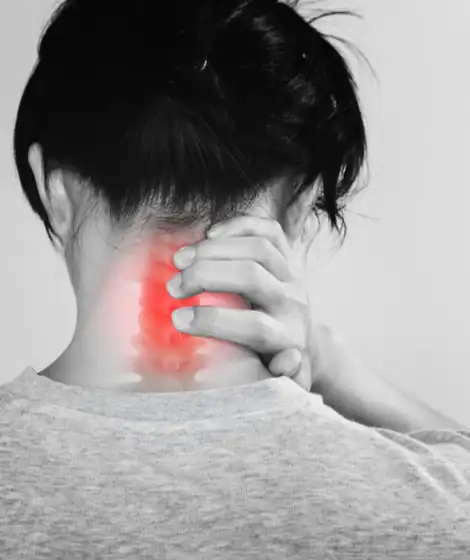
Common Symptoms: Since cervical stenosis puts pressure on the spinal cord rather than a single nerve root, it causes symptoms in both arms and legs. Common indicators include numbness or weakness in the shoulders, arms, or legs, along with hand clumsiness and difficulty with fine motor tasks. Neck pain may be present, though it may not be the most prominent symptom. People with cervical stenosis may not realize the problem is in their neck if symptoms are localized in other parts of the body.
Cervical stenosis can cause clumsiness, balance problems, gait disturbances, and erratic leg movements that make walking difficult. In more severe cases, bowel or bladder problems can develop.
Diagnostic Process: Diagnosis begins with a thorough physical exam including an X-ray of the cervical spine to look for problems such as tumors or fractures that can cause narrowing of the spinal canal. This is usually followed by an MRI, which is the best choice because it can show if the spinal cord is compressed and where the narrowing is located. It can also show damage to discs, softening of the spinal cord known as myelomalacia, or other problems within the spinal cord itself.
Medications to reduce inflammation and pain, combined with physical therapy, may help in mild cases. Epidural steroid injections are another option for relieving pain, but they will not reverse the physical compression of the spinal cord.
If symptoms do not respond to conservative therapy, surgery to take pressure off the spinal cord and create more space within the spinal canal may be warranted. Anterior cervical corpectomy, posterior cervical decompression, and fusion, which may include laminectomy to remove bone compressing the spinal cord, or anterior cervical decompression may be performed depending on the location and severity of compression. If symptoms are severe, immediate surgery may be unavoidable.
Vanessa had years of neck pain leaving her unable to even do her daily work. But with Dr. Wascher’s quick and timely intervention that included multiple viewings of MRIs, muscle and nerve tests, followed by a 3-Level Anterior Cervical Fusion, she is now happy without any neck issues. “I can happily say that by following the recommendations of Dr. Wascher, I am now pain-free,” says Vanessa as she talks about how great Dr. Wascher and his team were to work with.
When Nanette experienced deep pain in her shoulder, she got tests performed, only to discover that she, in fact, had issues with her neck instead. After a few MRIs and scans, she contacted Dr. Wascher, who told her that she has bone spurs going into the spinal cord. Within a span of 3 weeks, she was able to go through surgery and get on the road to recovery. “I cannot say enough about Dr. Wascher’s expertise and empathy”, says Nanette as she joins an ever-growing community of people who, through Dr. Wascher and his team, have found happiness again.
Dr. Thomas Wascher brings over 30 years of specialized cervical spine expertise to the treatment of cervical stenosis. He has performed over 4,500 cervical spine surgeries during his career, with over 252 anterior-posterior cases achieving a 99% improvement rate. Dr. Wascher's microscopic surgical techniques result in smaller scars, less pain, and faster recovery.
The practice offers free MRI reviews and second opinions at 5320 W. Michaels Dr., Appleton. Dr. Wascher graduated valedictorian from high school, college, and medical school, and has been recognized as one of America's Top Surgeons since 2007.




Cervical stenosis involves narrowing of the central spinal canal where the spinal cord passes, causing symptoms in both arms and legs. Foraminal stenosis involves narrowing where nerve roots exit, typically causing symptoms in only one arm.
Cervical stenosis describes the anatomical narrowing of the spinal canal, while cervical myelopathy describes the spinal cord dysfunction caused by compression. Stenosis is the structural problem; myelopathy is the resulting cord damage.
Yes, cervical stenosis can cause significant walking difficulties. Compression of the spinal cord can lead to clumsiness, balance problems, and erratic leg movements, making walking difficult.
Cervical stenosis is often a progressive degenerative condition. Without treatment, ongoing degenerative changes can cause increased narrowing and worsening symptoms.
Most people respond well to surgical decompression. At Wascher Cervical Spine Institute, Dr. Wascher has achieved a 99% improvement rate, with significant improvement in walking, balance, and arm and leg function.